First, the thing nobody checks
Your room may already have a switch that works. It just controls an outlet.
In a lot of North American bedrooms there is no ceiling fixture at all, and instead one half of one wall outlet is wired to the light switch by the door. It is called a switched outlet, and it is easy to miss because the outlet looks completely ordinary.
Before you buy anything, find it. Plug a lamp into the top socket of every outlet in the room and flip the wall switch. Then do the same with the bottom socket. If a lamp turns on and off with the switch, you have just found the most valuable outlet in the room: whatever you plug in there becomes your ceiling light, without a ceiling light.
If nothing responds, the room genuinely has no switched circuit. That is fine — it just means the job of “one switch turns the room on” moves to a remote or a smart plug. See one switch, three lamps below.
The rule
Three sources, all below eye level, all the same colour.
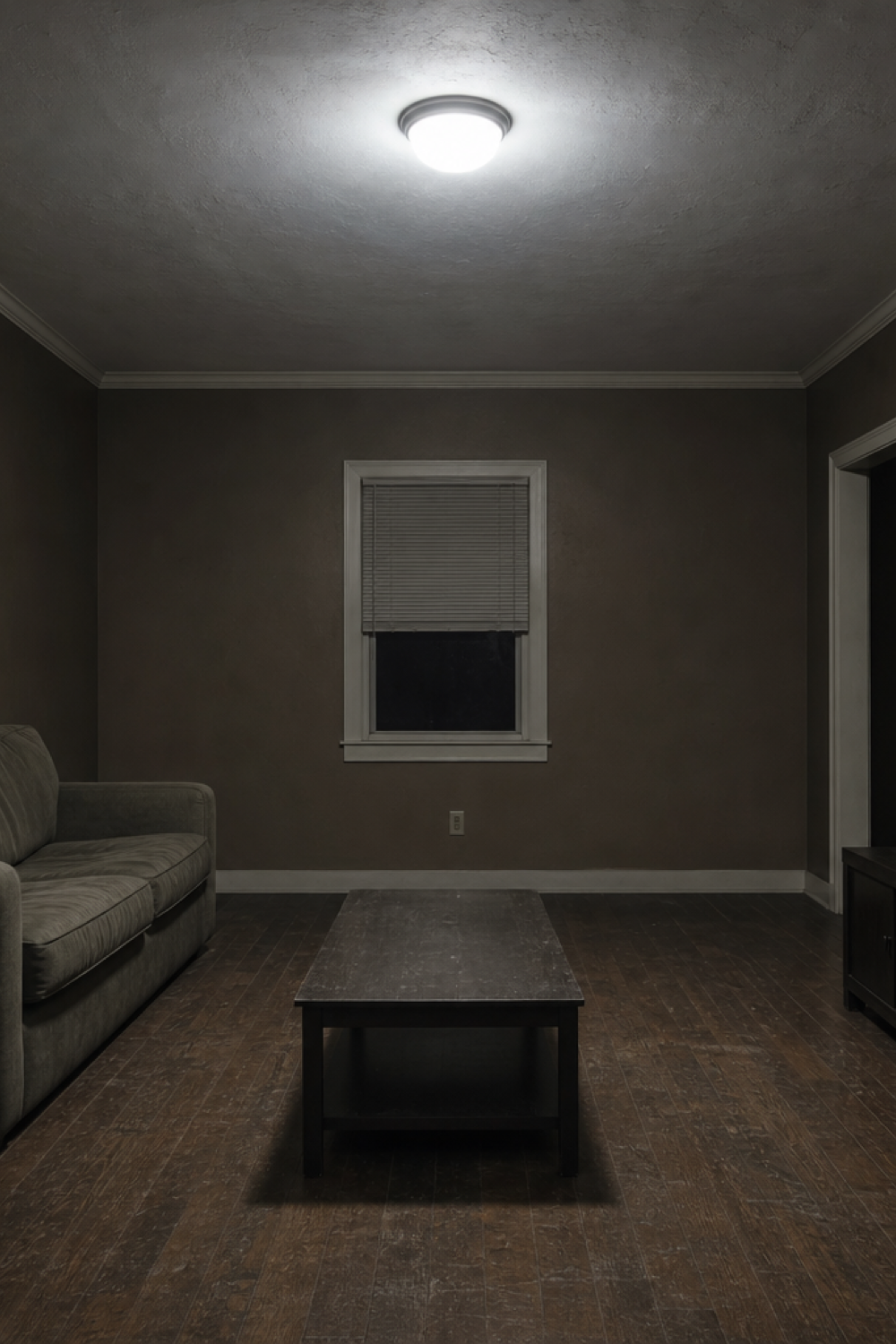

A ceiling light lights a room the way a parking garage is lit: evenly, from above, with no shadows. Even is the problem. A room reads as calm when light comes from several low points and leaves dark between them — that gap is what makes a room feel deep instead of flat.
So the target is not “replace the ceiling light.” It is three pools of light at different heights, none of them above your head when you are standing:
-
01
A floor lamp in the far corner — the one you see from the doorway. This is the light that makes the room look inhabited before you have touched anything else. Shade pointing down or sideways, not up at the ceiling.
-
02
A table lamp beside where you sit or sleep — nightstand, side table, desk corner. Roughly at shoulder height when seated. This is the one you actually use.
-
03
One low accent — a small lamp on a shelf, a plug-in uplight behind a plant, a strip hidden behind the headboard. It costs the least and does the most for how the room photographs and how it feels at 10 p.m.
The number on the box
2700K, or you undo everything above.
Lumens tell you how much light. Kelvin tells you how the room feels, and almost everyone buys on the wrong one. 2700K is lamplight — warm enough to read as evening, bright enough to read a book by. Anything at 4000K and up is office light, and your brain reads office light as work no matter how nice the lamp is.
Two more things printed on the same box, both worth the ten seconds:
- “Dimmable.” Printed on the box, not implied. Non-dimmable LEDs buzz and flicker on a dimmer, and you will want a dimmer eventually.
- CRI 90+. Colour rendering. Below 90, your walls and your skin go slightly grey and you will not know why.
Bulbs cost $4–15 each. Swapping the bulbs already in your lamps changes a room more than a new lamp does, and it is the cheapest thing on this page.
The part people give up on
One switch, three lamps.
This is where most no-ceiling-light rooms fail. Three lamps is the right answer, and walking around the room turning three knobs is the reason people stop doing it after a week and go back to the overhead light in the hall.
Pick one of these and the problem disappears:
- The switched outlet, if you found one. Put a three-way splitter or a power bar in it and run as many lamps to it as reach. The wall switch by the door now turns on the room.
- Smart plugs ($10–15 each) grouped together, with a small stick-on remote or button by the door. No hub, no drilling, no app required to use it day to day.
- A plug-in remote switch set — the dumb version of the above, one remote and three receivers, about $25 for the set.
Whichever you pick, put the control by the door. The test is whether you can turn the whole room on without walking into a dark room first. If you cannot, the plan will not survive a month.
Rental-safe
Nothing that drills, nothing your landlord can charge for.
- Clamp lamps on a shelf edge, a headboard, or a bookcase side — the only way to get light high in a corner with zero fixings.
- Leaning beats mounting: a tall thin floor lamp in a corner does the job of a wall sconce and moves out with you.
- Over-door hooks and picture ledges for anything you would otherwise screw in.
- Skip adhesive strips on painted walls. They take paint off on the way out more often than the packaging suggests. Behind furniture and on non-painted surfaces, fine.
- Do not touch the wiring. Hard-wiring a fixture into a room you do not own is the one item on this page that can cost you your deposit — and in most leases, more than that.
Four ways this goes wrong
What not to do.
- One very bright floor lamp aimed at the ceiling. You have rebuilt the ceiling light, with an extra step. Torchieres bounce a flat sheet of light off the ceiling and remove every shadow in the room.
- String lights as the main source. They are an accent. Used as the only light, the room stays dim and reads as a dorm.
- Mixed colour temperatures. One 4000K bulb among three 2700K ones is more obvious than three of anything. Match them all, including the closet and the hall if you can see both at once.
- Buying the lamps first. Decide where the three pools of light go, then buy the shapes that fit those spots. Doing it the other way round is how people end up with a lamp that has nowhere to be.
If you would rather not work it out
Send me the room and I will send back the plan.
Everything above is general. Your room has one outlet in the wrong place, a window facing the wrong way, and a fixture you are not allowed to remove. That is the part a guide cannot solve.
Send two or three photos with the lights on. Within 48 hours you get where each light goes, at what height, what colour temperature, and the exact shopping list with prices — usually three items, usually under $80 total. $75 CAD, paid after the plan arrives, not before. If it does not work in your room, you pay nothing.
And if a $10 bulb would fix it, I look at the photos and tell you that instead, and charge you nothing. That happens more often than you would think.